


News

Hot Articles
-

Australia Visa Fee Changes: FY2025/26 vs FY2026/27 Comparison
- Sponsoring a Motor Mechanic in Perth: 482, 186 and 494 Visa Options for Auto Repair Businesses (2026 Guide)
- How Perth Engineering Companies Can Sponsor Overseas Engineers: 482, 186 and 494 Visas Explained (2026 Guide)
- Major Australian Immigration Overhaul Announced: Student Visa Family Restrictions & 6 Key Changes Explained (September 2026 Update)
- Sponsoring Nurses and Carers in Perth & Regional WA: 482, 186 and 494 Visa Options for Aged Care and Disability Providers (2026 Guide)
- Offshore VET Visa Approved
How Perth Engineering Companies Can Sponsor Overseas Engineers: 482, 186 and 494 Visas Explained (2026 Guide)
2026.09.11
If your Perth engineering business has spent months advertising a role with no suitable local applicants, you are not alone. Skill shortages across civil, structural, mining and electrical engineering remain one of the most common hiring problems we see from Western Australian employers.
Employer sponsorship is often the answer — but the visa system can look intimidating from the outside. In this guide, we break down the three main pathways, who they suit, and what the process actually looks like for your business.
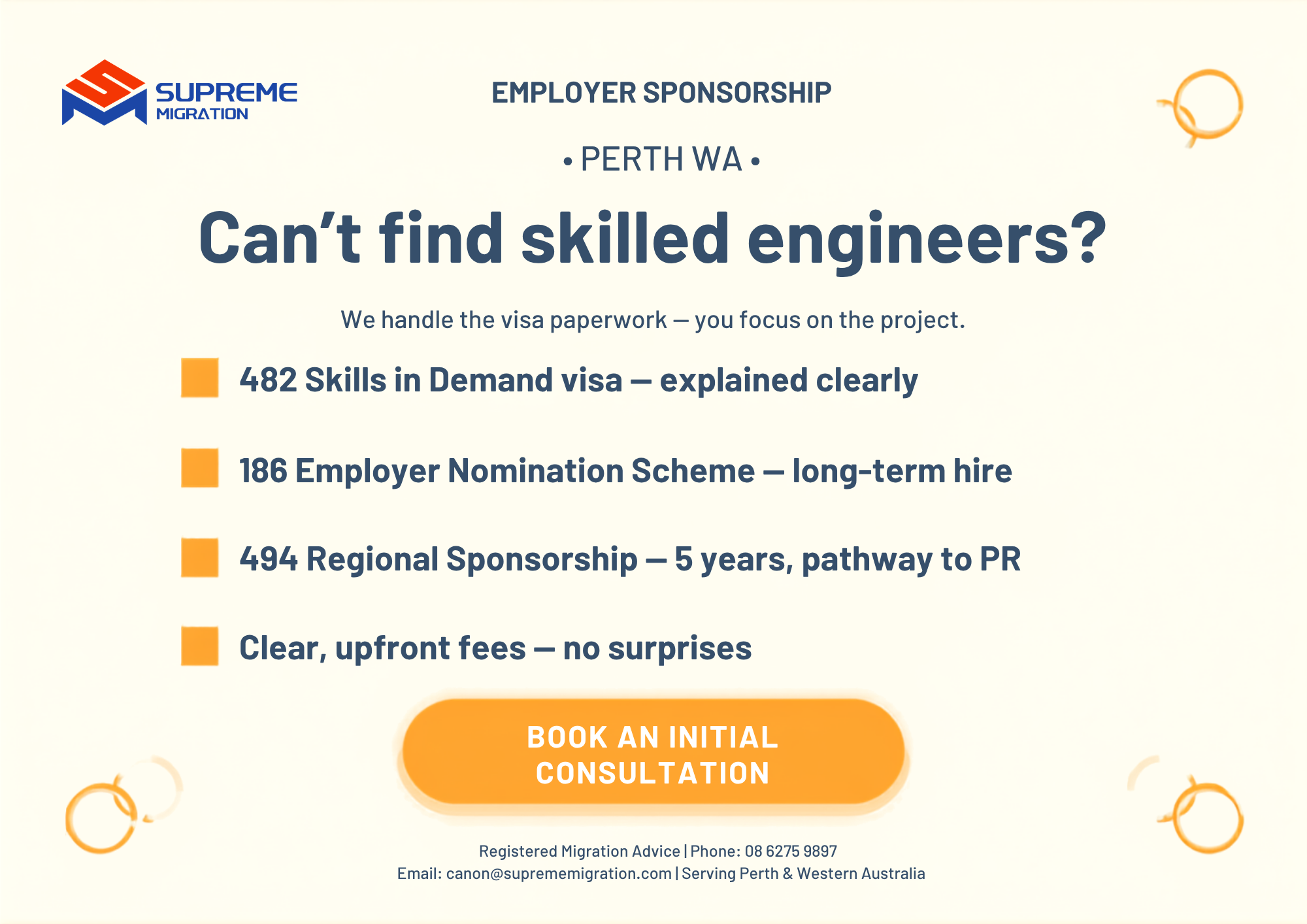
The three main visa pathways
1. Skills in Demand visa (subclass 482)
The 482 replaced the old TSS visa in December 2024 and is now the standard visa for hiring overseas workers on a temporary basis.
- Duration: up to 4 years per visa
- The role must be on the relevant skilled occupation list and meet a minimum salary threshold (the Core Skills Income Threshold, indexed each financial year)
- The nominated occupation generally requires the applicant to hold a relevant qualification and, for most engineering roles, a positive skills assessment
- After 2 years working with your business, the employee becomes eligible for permanent residency through the 186 visa (Temporary Residence Transition stream)
Best for: businesses that need an engineer now and want the flexibility to decide on permanent residency later.
2. Employer Nomination Scheme (subclass 186)
The 186 is the main permanent visa and comes in two streams:
- Direct Entry: for candidates with a suitable skills assessment and (for most applicants) at least 3 years of relevant experience
- Temporary Residence Transition: for existing 482 holders who have worked with your business for 2 years
Best for: businesses ready to commit to a long-term hire, or retaining an engineer who is already with you on a 482.
3. Skilled Employer Sponsored Regional visa (subclass 494)
Many Perth employers are surprised to learn that Perth officially counts as a "regional" area for migration purposes.
- Duration: 5 years
- A broader occupation list applies than for the 482
- After 3 years, the employee can apply for the permanent 191 visa — and this pathway does not require the business to nominate again
Best for: regional WA roles, or where the occupation is not available under the 482.
What does the process look like for your business?
In most cases, the steps are:
1. Eligibility check — confirm your business is a lawful, operating business and can meet salary and employment conditions
2. Nomination — you nominate the position (and pay the Skilling Australians Fund levy, which is based on your business turnover and the visa length)
3. Visa application — the engineer applies, providing skills assessments, English test results and documents
4. Decision and start date — most well-prepared applications are processed within months, though timeframes vary
What does it cost?
Government fees change regularly, so treat any figure you see online as approximate. As a guide, budget for: the nomination charge, the SAF levy per year of the visa, the visa application charge, and any skills assessment and English test costs paid by the candidate. Professional fees for managing the process are quoted upfront before any work begins.
Is sponsorship right for your business?
Employer sponsorship works best when three things line up: a genuine role you cannot fill locally, the salary budget to meet visa thresholds, and an engineer who meets skills and English requirements. A short initial consultation is usually enough to work out whether your position qualifies — and which of the three visas above is the most cost-effective route.
Get clear advice before you commit
At Supreme Migration, we specialise in employer-sponsored visas for WA businesses. We will tell you plainly what is possible, what it costs, and how long it will take — no obligation beyond the consultation fee.
Book an initial consultation: (08) 6275 9897 or canon@suprememigration.com. Consultation fees apply.
MARN: (2418636)





- Migration Visas
- Employer Sponsored Visas
- General Skilled Migration Visas
- Family Visas
- Citizenship & Resident return Visas
- Administrative Review Tribunal
- Humanitarian Visas
- Enrolment & Student Visa
- Student & Guardian Visas
- Australian School Enrolment
- Contact Information


